FORM TWO
SOCIAL-ECONOMIC DEVELOPMENT AND PRODUCTION IN
PRE-COLONIAL AFRICA.
SOCIAL ORGANIZATION AND PRODUCTION.
Social organization refers to mode(s) of production existing in a particular place at a particular time. Basically it constitutes productive forces and relations of production.
Social organization and production means the way people interact and relate to each other in the process of production in the society. In the process of struggling against nature in order to get the basic needs such as food, shelter and clothing man comes into relations with another.
In Africa the dominant social organizations (modes of production) include communalism, slavery and feudalism
- TYPES OF SOCIAL ORGANIZATIONS AND PRODUCTION.
Communalism
Primitive communalism came into existence about two million years ago and was the first socio-economic mode of production in which evolution of the society started. It covered the period of stone and iron ages.
In the beginning, people were powerless before their environment.
Communalism was the first mode of production whereby the major means of production were owned by the society.
Characteristics (Features) of Communalism
- The instruments of labour were very crude and underdeveloped.
- Low level production.
- The major means of production were owned communally.
- There was no exploitation of man by man.
- There were no classes.
- All the able- bodied people worked and produced.
- Man lived by hunting and gathering.
- The products of labour were fairly and equally distributed.
- Slavery
This was the second mode of production in human society and the first exploitative mode of production.
The availability of surplus created two classes, the poor and the rich with the rich enslaving the poor. Examples the Ganda, Haya, Chagga, Kerewe, Sambaa and Coastal societies.
The use of slaves.
The slaves were used in the following ways:-
- To build cities and large structures, such as the Egyptian pyramids.
- To construct dams and irrigation schemes in Egypt.
- Slaves mined silver, gold and iron.
- To cultivate land.
Features of Slavery.
- Major means of production were owned by slave masters (private ownership of the means of production).
- There were classes of the slaves and slave masters.
- Improvement of instruments of labour.
- There was surplus of production.
- Existence of strong political institutions.
Feudalism
This was the second exploitative mode of production. There were two classes in the society, the haves (landlords) and the have nots such as the serfs and peasants. The haves owned lands or cattle, whereby the peasants were exploited by the landlords through payment of rents.
Characteristics of Feudalism.
- Feudal lords owned major means of production.
- The instruments of labour were more improved.
- Their was exploitation of man by man.
- The division of labour was very wide.
- There was surplus production.
- Existence of strong political institutions.
There were three types of rents:-
- Labour rent, is the kind of rent whereby the peasants and serfs had to work (to render services) for their masters (feudal lords).
- Rent in kind, this was the type of rent whereby the peasants or serfs had to pay an agreed amount of their produce.
- Money rent, this was the type of rent in which a peasant or serf had to pay an agreed sum of money to his master.
Feudalism Among African Societies.
The feudal mode of production in African societies existed in different forms.
- The feudal relation in Karagwe and Buhaya was known as Nyarubanja.
- In Buganda, it was known as Mvunjo and Busulo.
- Ubugabire system developed between the Tutsi and Hutu in Rwanda, Burundi and Buha.
- Among the Nyamwezi, Sukuma and the Gogo feudalism was known as
- Along the Coast of East Africa the type of feudalism was known as
Power Sharing under Feudalism
Power sharing is a ruling system in which two or more communities or governments rule the same territory and people.
During feudal mode of production, this system was practiced so as to decentralize the power of kings or landlords. The Kings or landlords shared some of the responsibilities with other classes such as Chiefs.
Merits of power sharing during African Feudalism
- It brought equality (though minimal) among the respective communities.
- It maintained and strengthened the supremacy of kingdoms due to the aid of principles of centralization.
- It led to the participation of the leaders and community members at large.
- It brought the sharing of cultural practices as well as their preservation. For example in order to maintain unity, the Kabaka in Buganda kingdom had to marry from each clan.
Demerits of power sharing during the African Feudalism
- The powers and privileges rested on a small group of people (minority), that is, it brought monopolization of power by few.
- It led to the emergence of dictators among the leaders due to absolutism.
- It favoured nepotism among the people as it belonged to the ruling class and their families, clan or tribe.
- It caused dissatisfaction especially among those who were not privileged by the system.
- It laid foundation for political and social instability in some countries particularly in Uganda.
CHAPTER TWO
INTERACTIONS AMONG THE PEOPLE OF AFRICA.
Social and Economic Factors for Interactions.
EAST AFRICA’S NEIGHBOURS
The neighbours of East Africa are the people living in Zaire (DRC present day) Zambia, Malawi and Mozambique. The other neighbours are the people of North East Africa, these live in Egypt, Sudan, Ethiopia, Eritrea and Somalia. Sometimes Ethiopia, Eritrea and Somalia are reffered to as the Horn of Africa. Societies in these regions were engaged in activities similar to those taking place in East Africa by 1850. These activities included agriculture, pastoralism, craft and trade.
The main social and economic factors which gave rise to the interactions among the people of Africa were to conduct trade.
The Impact of Economic Interactions:-
- Growth of towns and cities such as Gao, Walata, Timbuktu (West Africa), Alexandria, Tripoli and Cairo (North Africa), Malindi, Mombasa, Bagamoyo, Tabora and Ujiji (East Africa).
- Exposure of Africa to the external World. With trade Africa came into contact with the outside world thus importing and exporting goods.
- Intensification of agricultural production, this was due to the availability of better tools.
- The interaction led to the emergence of the classes, the rich and the poor.
- The integration brought with it new demands.
- Traditional manufactures such as hoes, salt and cloth were pushed to secondary positions.
- Imports, cheaper and highly competitive commodities such as clothes, beads and guns flooded local markets in exchange for slaves and ivory.
- Industries such as Iron smelting among the Yao and Makua and cloth making in the Shire (Malawi) and Luangwe valleys declined.
- The coming of the Ngoni (The Ngoni migration into East Africa).
Introduction
Who were the Ngoni and where did they come from?
In origin, the Ngoni were close relatives of the Zulu, a dominant tribe in South Africa (Natal region). They were both agriculturists and pastoralists.
The Ngoni were essentially full time warriors and lived mainly by plundering (stealing) especially cattle. These people migrated from South East Africa and moved Northwards towards East Africa moving through Central Africa.
Background to Ngoni Exodus (or causes of Ngoni Movement Northwards) or why did they leave their homeland to come to East Africa?
- Population expansion (pressure)
In their homeland, there was population expansion and therefore, there was increased pressure on the land.
It was not easy for these Ngoni speakers to extend their territory. This was because there were the Drakensberg mountain in the West. In the East there was the Indian ocean. Expansion Southwards was difficult because of the Boers’ expansion Northwards.
In other words, population pressure led to scarcity of vital resources such as fertile land and pastures and thus this situation necessitated their migration into East Africa.
Outbreak of Civil Wars.
Their migration was also caused by the tyranny (cruel use of power or authority) of SHAKA, the Zulu chief who had embarked as expanding his Kingdom and in about 1818, the Ngoni were defeated by this man. As the result, the Ngoni fled Northwards in order to avoid forcible incorporation in the empire of tyrant Shaka.
Note:-
This period of turmoil or troubles in South Africa is known as the Mfetsane or Mfecane.
Many scholars define Mfecane simply as a war of wondering in South Africa caused by Shaka’s system of rule.
OR
We can precisely define it as time of trouble started in South Africa which was associated with the rise of Shaka Zulu in early times around 1820’s to 1830’s.
Describing their movement and Settlement in East Africa.
- In their movement the biggest group of the Ngoni was led by ZWANGENDABA. Originally, this group settled in Ufipa between lake Nyasa and Tanganyika. After the death of Zwangendaba in 1845, however, this group split into five parts. Three of these moved into Zambia and Malawi and only two remained in East Africa. These were the GWANGARA led by Zulu Gama and the TUTA led by Mpangalala.
- Another larger group was of the Maseko Ngoni led by chief MAPUTO. This group had taken a different route; they travelled on the Eastern side of Lake Nyasa and finally settled near Songea. But they were later withdrawn by the Gwangara and so moved Southwards to Morogoro where they became known as the MBUGA. That is how the NGONI moved into and settled in East Africa.
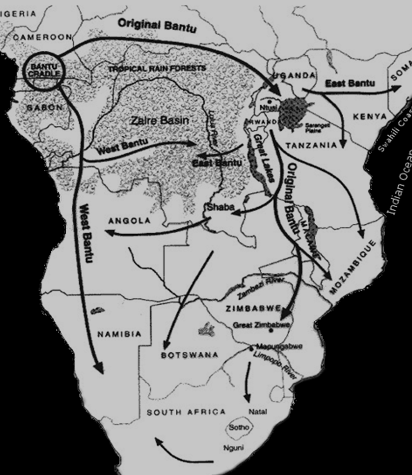
Fig: Nguni Movement Northwards to East Africa.
Why were the Ngoni Successful against East African people?
The Ngoni were successful in their invasions of East Africa because of several factors.
Big man power
First and foremost in the course of their movement, they captured and incorporated young men into their army and young women who became wives. This added to their man power and the big Ngoni armies easily defeated their enemies.
Superior military Organization
The Ngoni had superior military organization copied from SHAKA and DINGISWAYO, both chiefs of the Zulu. This organization included:-
- Vigorous training, very well trained soldiers, age regiments, using strange fighting tactics like;
- Using short stabbing spears.
- Using a cow’s or buffaloes horns method of surrounding an enemy.
- Attacking from the front, fighting units (age regiments), making surprise attacks. All this was more than enough to crash the untrained disjointed enemies.
Unity.
The Ngoni were well organized with the people fully united under their leaders, the people of Southern Tanzania were weak and in small disintegrated societies which lacked strong central organization of any kind.
Conclusion.
For the above reasons, therefore most of the societies of East Africa were unable to challenge the Ngoni military organization and superior weapons, leave aside the fact that the young brave Ngoni men were always eager to fight and were in very big numbers and they always outnumbered their enemies.
All in all, the Ngoni couldn’t be defeated.
The Effects of the Ngoni Migration.
SOCIAL EFFECTS.
Depopulation:- As the result of the coming of the Ngoni, there was depopulation as villages were destroyed and many people were killed during the fierce wars and others were killed by the “Rugaruga” and “Mavit”.
Detribalization:- People became displaced, homeless and without their tribesmen (detribalization). The survivors of the chaos organized themselves into groups;
“Rugaruga” and “Mavit” who roamed every where stealing and killing people. These groups could be given money or property to fight for chiefs (Mirambo used them).
Famine and diseases:- The Ngoni raided widely for cattle thus they destroyed the wealth of the people. In such situation, even cultivation wasn’t possible. So famine coupled with diseases, made life very difficult. There was much suffering.
Introduction of Ngoni language and culture:- Those who were conquered had to learn them.
The increase of Ngoni:- Since defeated people were absorbed and taught the Ngoni culture, the Ngoni increased both in population and strength.
Suffering and chaos:- Since the activities of the Rugaruga and the Mavit took place when slave trade was at its peak, this made slave to intensify and the result was untold suffering much chaos especially in Tanzania.
POLITICAL EFFECTS.
- Establishment of Empires:- With the services (help) by the “rugaruga” the ambitious chiefs were able to establish empires for themselves and to expand them. Good examples being those of Mirambo and Nyungu ya Mawe among Nyamwezi people.
- Another positive change was that many societies now learnt Ngoni tactics of fighting and the Ngoni superior weapons were also copied.
- Creation of some other new empires by the fleeing Nguni.
These states include
- Njeru and Mbonane states under Zulu and Mbonane respectively in Tanzania.
- The Ndebele states in Zimbabwe under Mzilikazi.
ECONOMIC EFFECTS.
- Disturbing (Interruption) of the Arab Trade.
The Ngoni invasion disturbed the Arab trade between Tabora and Ujiji.
These were the TUTA who interfered with the trade and else where in Southern Tanzania, trade was disrupted.
- Hindered the agricultural development within the area of migration.
It can be summarized that effects caused by Ngoni migration were both destructive and constructive, likewise, they were short lived and long term in one way or the other.
DISCUSSION QUESTIONS
- Who were the Ngoni and where did they come from?
- Why did they leave their homeland to come to East Africa?
- Describe their movements and settlements in East Africa
- Why were the Ngoni successful against East African people?
- What were the effects of their settlements on the societies of East Africa?
CHAPTER THREE.
AFRICA AND THE EXTERNAL WORLD
- Early contacts with the middle East and Far East.
The contact with the outside world namely Middle East and Far East placed the African continent into the international commercial system.
This contact had three important effects on the Coast.
- It integrated Africa into the world economy.
- It fostered the development of the Swahili civilization.
- It stimulated the development of the Coastal city states.
Historically, contacts between East Africa and the Middle and Far East go as far back as 200 B.C.
- Earlier commercial contacts are evidenced by archaeological excavations, they reveal remains of pottery, porcelain, coins, beads and tombs.
- The book, The Periplus of the Erythrean sea, written by Greek traders around the first century A.D is another evidence of such early contacts.
- The word “periplus” means a guide book.
- “Erythrean Sea” is the Greek term for the Indian Ocean. The book was therefore a guide to the sailors in the Indian ocean. The “periplus” contained interesting details about activities of the early traders of the East African Coast.
Monsoon Winds
Through out the year, strong steady winds blow across the Indian Ocean. For centuries these winds carried ships from east Africa to Asia and back.
The winds which blow to the East Coast from the North – East are called North – east monsoon winds. They blow from November to April. These winds brought the traders from Asia to East Africa.
The South East Monsoon winds blow in the opposite direction. They blow away from the Coast of East Africa towards the Coast of Asia between May and October.
Goods from East Coast
- Ivory, rhinoceros horns, animal skins, bees wax, tortoise shells, gold, copper, cowrie shells, slaves.
Goods from Asia
- Hard ware, beads and cotton came from India.
- Silk and porcelain came from China.
- Weapons, glass, iron ware, swords, daggers and spears came from Arabia and India.
- Food, such as wine and rice came from areas throughout Asia.
The Indian Ocean and the Monsoon Winds
Effects of Trading Contacts of East Africa.
Trading contacts between the East African Coast, the middle and far East had long lasting effects on East Africa.
The following were some of these effects:-
- Establishment (growth) of Coastal city states. Some of the most important city states were Kilwa, Zanzibar, Pemba, Lamu, Pate, Sofala, Malindi, Mombasa and Mogadishu.
- Introduction of Islam.
- Spread of Kiswahili.
- Introduction of New Arts and crafts, such as well built stone houses, writing, navigation, money changing and money lending.
- Expansion of trade.
- Exploitation of African resources.
- Decline of local industries.
- Contacts with Europe.
(i) The Portuguese.
The main social economic motive of the Portuguese intrusion along the East African Coast was to conduct trade. The Portuguese came into contact with the people of East Africa in the 16th and 17th centuries.
Aims of the Portuguese into East Africa.
- To monopolize the Indian Ocean
- To create a Portuguese empire in East Africa.
- To exploit the resources found in the East, including spices and silk.
- To prevent other European rivals from gaining access to this trade.
- To preach the Christian religion.
Why the Coastal city states were defeated?
The Portuguese were able to defeat the coastal city states because of the following reasons:-
- The Portuguese had superior weapons and experience in fighting at sea.
- The Coastal City states were disunited. Therefore the Portuguese used this weakness to defeat the Coastal city states one after another; e.g used Malindi to defeat Mombasa.
- The Coast was at the same time attacked in 1580’s by Galla, the Zimba who were inferior tribes and the Turkish pirates led by Amir Al Bey.
The Social and economic impact of the Portuguese to Africa (Results/Effects of the Portuguese Invasion on East Africa).
- The decline of the Coastal city states.
- It led to the decay (decline) of the Indian ocean
- They destroyed the Arab culture. Their religion (Islam) was threatened due to the coming of Portuguese Christianity.
- New agricultural crops such as maize, cassava, pineapple, groundnuts and rice were introduced.
- Introduction of some Swahili words such as meza.
- Mozambique continued to experience the brutality of Portuguese for over two hundred years (that is introduction of colonialism in Mozambique).
- They built Fort Jesus, which is a great tourist attraction in Kenya.
Fig: Portuguese Power in the Indian Ocean from 15th -17th century
Resistance to Portuguese Intrusion.
There were three major sources of resistance against Portuguese intrusion:-
- It was from the feudal lords.
- Also the reaction was done by the traders who wanted to protect their economic interests.
- From common people who were dispossessed their property.
The reasons for the fall of the Portuguese rule in East Africa (i.e the Reasons why the Portuguese failed in East Africa).
- They did not have enough man power to administer large city states and territory.
- The Coastal city states received the assistance from Oman.
- Due to the interruption of religion and culture the Coastal people disliked the Portuguese.
- They suffered from tropical diseases such as Malaria.
- The Portuguese in charge of administration were corrupt, inefficient and untrustworthy.
- Bitterness, harsh treatments and punishment by the Portuguese weakened their leadership.
- There was a loss of trade due to Portuguese taxes and restrictions.
All in all it can be concluded that the fall of the Portuguese rule in East Africa was mainly due to the help by the Oman Arabs to the East Africa Coastal people.
In 1652 the Sultan of Oman sent a few ships to the East African Coast. They made a few raids and went back.
In 1696 Seif bin Sultan of Oman sent seven ships and three thousand men to Mombasa. This was the beginning of the siege of Fort Jesus that was to last for two years. Portuguese rule on the East African Coast from Pate to Cape Delgado ended with the capture of Fort Jesus in 1698. The Oman Arabs became the new masters along the Coast of East Africa.
(ii) Dutch Settlement at the Cape
Introduction.
In their endeavour to reach the centers of trade in India and the far East, European merchants successfully rounded the southern tip of Africa towards the end of the 15th century.
The first merchant explorer to round the South African Cape was Vasco da Gama, a Portuguese who reached the Cape in 1498 A.D.
Apart from Vasco other Europeans who came and established permanent settlement were the Dutch from Holland. They settled at the cape in 1952. This was the period of merchant capital in Europe where it was necessary to trade both in and out of the Europe. They formed the Dutch East India Company at Table Bay.
The Dutch settlers who established themselves as stock farmers became known as the Boers. They farmed and at the same time kept cattle. They were also called Afrikaners.
The language that evolved among them was called “Afrikaans” a corruption of the original Dutch language.
The motives (reasons) for the Dutch settlement at the Cape.
- The Cape was half way journey from Europe to India, that is, they could stop, rest and refresh.
- They established farms where they grew vegetables, also they sold meat and vegetables to sailors.
- It was easy to repair and make services to ships after and before cape’s storms.
- They built hospitals at the cape where sick sailors could get services.
- The Boers established relations with Khoikhoi in order to be accessible to meat from Khoikhoi.
The impact (effects) of Dutch settlement at the Cape.
- The Boers obtained cattle through raiding of the Khoi and the Xhosa cattle.
- Through raiding the cattle they shot people at random and hence caused death.
- The settlers also grabbed Khoi and Xhosa agricultural land.
- They turned the indigenous people especially the Khoi into slaves and squatters.
Afro-Boer confrontation (1780 – 1820).
The Africans reacted against these settlers mainly because of being grabbed of their land and because of being turned into slaves by staging the war.
The Afro-Boer clashes continued until the year when the British established their over rule on the cape in 1795.
N.B The Boers are the ones who started Apartheid policy which means separateness.
- Slave Trade in the Indian Ocean seaboard and Trans- Atlantic Slave Trade.
* Reasons for the Expansion of slave trade in the Indian Ocean seaboard from the 18th
century were:-
- Development of maritime technology which facilitated sailing.
- The rise of feudalism led by strong political organization.
- The great demand of labour by the French and Dutch to use slaves in the Indian ocean islands of Mauritius and Reunion.
- The expansion of the Industrial revolution from England to other European states.
Oman Interests in East Africa.
After the Oman conquest of the Portuguese, Oman administration was established. When the Arabs helped the people of the Coast to defeat the Portuguese their aim was to get control of this trade.
Thus we can say that the rulers of Oman wanted to dominate the East African Coast from the 18th century because of the following reasons;
- They wanted to control (rule) the East African people.
- They wanted to dominate the trade along the Coast.
- It would also enable the Oman Sultan (ruler) to collect taxes and customs duty from the traders.
Why Sultan Seyyid Said shifted his capital from Muscat in Oman to Zanzibar?
In 1840 Sultan Said shifted his capital from Muscat in Oman to Zanzibar. He stopped ruling East Africa from Oman. Instead from then onwards, both Oman and East Africa were to be ruled from Zanzibar.
Reasons:-
- He liked the Coast of Zanzibar because it had good climate, it was not as hot as it was in Oman.
- To rule and control the mainland which was the main source of wealth.
- Zanzibar had fertile soil for clove and coconut plantation.
- It had a good harbour with deep water.
Note:-
- The Oman Arab rulers expanded clove and coconut plantations in Zanzibar because they wanted to establish clove and coconut economy for conducting trade with the outside capitalist world such as Britain, Germany, France and United States of America.
- Sultan Said encouraged Arab settlement in Zanzibar for more expansion and production of cloves and coconuts, thereby local people became landless and agricultural workers (slaves).
The techniques used to get slaves.
Slaves were obtained through various ways:-
- Through raiding villages and capturing people.
- Through selling prisoners of war obtained from local wars.
- Through selling criminals (people with mistakes).
- Through selling of domestic slaves.
- Through way laying and ambush.
- Through the use of trickery and false pretence.
The Social and Economic Effects of Slave Trade on the African Societies.
The slave trade lasted for about 400 years. The effects to Africa were many and terrible. They were all bad. Nothing good could be brought about by slave trade.
The following were the results;
- Loss of labour of the young and healthy.
- Technical retardation.
- Collapse of economic activities.
- Dehumanization and humiliation.
- Fear and insecurity among the people.
- Hunger (starvation) due to lack of enough food.
- Some Kingdoms like Congo and Lunda declined because of trade.
N.B: Slavery caused psychological effects on its victims particularly fear and insecurity. For all the time people could not settle in their homes as any time they expected to be taken as a slaves. Also the slaves all the time did not have the peace of mind.
* The Trans- Atlantic Slave trade in Africa (Triangular Slave Trade).
It was the type of slave trade which involved three regions, that is America (North and South), Europe and Africa (West Africa) between 16th and 19th century.
- The origins of Trans – Atlantic Slave Trade (Factors for its rise)
- The development of maritime technology. This enabled traders from Europe to sail up to West Africa.
- The role played by the crusade wars in the Middle East between the Muslims and Christians in Turkey. It was because of these wars that the normal land route to Asia was blocked and hence European traders were forced to take an alternative route to India, so it was this alternative route which made the European traders to reach West Africa.
- Europeans in America while in search of alternative route to India. (The discovery of American continent). CHRISTOPHER COLOMBUS a Spanish reached America. It was found that the climate was found ideal for sugar plantation and silver mines.
Due to availability of gold and silver and tropical crops such as cotton and sisal, there was a needed of exploitation of these resources.
At first the Europeans to solve the problem of labour they employed the Red Indians and European convicts. But the Indians died of new European diseases and were physically unfit.
The Portuguese and the Spanish then turned on Africans. The Africans taken to the Americas survived disease, physical strains and related hardships better than the other groups hence forth slaves were taken from Africa.
(ii) Regions involved.
- Western European countries i.e Portugal, France, Britain, Spain and Holland.
- The Atlantic Coast of Africa.
West Africa, the Congo, Angola and Southern Africa.
- The Americas – South and North America and the Caribbean Islands.
(iii) The major commodities (items) involved.
- EUROPE: Clothes, firearms, utensils, glassware, alcoholic drinks, tobacco pipe.
- THE AMERICAN/CARRIBEAN/WEST INDIES.
Cotton, sugar, rice, gold, silver, timber, furwool and indigo.
- AFRICA: Slaves, gold, hides, gum, timber, kolanuts, palm oil, pepper, bees wax and other tropical products.
Fig. The Triangular Trade
(iv) Effects on Africa
- Economic effects.
- Decline of local industries.
- Retardation (setback) of economic activities in Africa such as agriculture, pastoralism and fishing.
- The decline and collapse of the Trans-Saharan trade and the development of legitimate trade ( a trade in other goods than human beings).
- It led to the underdevelopment and over exploitation of African resources.
- The removal of strong labour force from Africa.
- The Africans more especially chiefs who were involved in the trade became rich.
- The Social – cultural Effects.
- Creation of fear and insecurity.
- Destruction of property such as houses were set on fire and crops.
- Loss of dignity by the Africans.
- There was intermarriage between races involved in the trade.
- The methods of obtaining slaves retarded the growth of African culture that is there were no longer traditional ceremonies and tribal and social gathering.
- Christianity and European culture spread into Africa.
CHAPTER FOUR
TRANSITION TO INDUSTRIAL CAPITALISM.
- Demands of Industrial Capitalism (Competitive capitalism).
Meaning of Industrial Capitalism.
It was the second stage of capitalism whereby there was growth of industries in Europe which demanded raw materials to feed them.
Industrial capitalism began in England in the middle of the 18th century. Later in the 19th century, other countries began to industrialize. Among these countries were France, Germany, Belgium, Italy and U.S.A.
With the development of industries in Europe, these industries in Europe needed different demands in order for the industries to develop, these demands were as follows;
- Raw materials to feed the European industries which were both agricultural and mineral raw materials such as cotton, gold, iron etc.
- Expansion of markets, where to sell the manufactured goods.
- Labourers to produce raw materials.
- Agents of Industrial Capitalism (The forerunners of colonialism).
These were European personnels who prepared the way of colonialism in Africa. The most prominent agents of capitalism were Traders, Explorers and Missionaries, others were associations and companies.
TRADERS.
The first Europeans to enter the interior of East Africa were traders. Most of these traders were BRITISH and GERMANS. They made Zanzibar their trading centre. From Zanzibar they extended their trading activities into the interior. Their activities mainly started after 1845.
- William Mackinnon.
A good example of such traders was Mackinnon from Britain. He formed a trading company called BRITISH EAST AFRICA ASSOCIATION based in Zanzibar.
In 1888 the association was granted a royal charter and became the imperial British East Africa Company (I.B.E.A.CO). It started operating in and administering Kenya and Uganda on behalf of the British government.
- James Stevenson.
He was a Scottish businessman, started a trading company known as Livingstonia Central African Trading Company. It operated along lakes Nyasa and Tanganyika.
- Harry Johnston.
This was also a British trader, who operated in Kilimanjaro and Upare areas before the 1886 Anglo – British treaty.
- Carl Peters.
After 1886, H. Johnston’s activities were superseded by those of the GERMAN EAST AFRICA COMPANY (G.E.A.CO). This company represented by Carl Peters in Tanganyika performed economic and administrative functions.
Roles of traders as agents of Capitalism.
- The traders acted as the main sources of information about Africa to their home capitalist governments.
- They opened a new exploitative system and therefore Africa became the target for European interests.
- They constantly appealed to their home governments so that they might use force to reduce the opposition from African middle men. These areas were later put under colonial control.
- They established communication system to the interior such as roads. These communication systems were used by the colonial masters to exploit African resources.
- MISSIONARIES
Other Europeans came to Africa as missionaries. They started coming after 1844. The main motives of the Christian missionaries were to spread Christianity in Africa and bring European civilization into East Africa.
Although the aim of the missionaries was to spread Christianity, they were also exploring the interior of East Africa. Some of these missionaries were financed by capitalist companies or associations.
Missionaries who came to East Africa.
- JOHN KRAPF.
He opened the first Missionary center at RABAI in 1846. He came to Zanzibar as a representative of the CHURCH MISSIONARY SOCIETY (CMS) of England. His aim was to convert the Galla to Christianity.
- JOHN REBMANN AND JACOB ERHARDT.
These joined Krapf in 1846 and 1849 respectively. They traveled extensively in the interior.
- OTHER MISSIONARIES.
Many other missionaries followed after 1870. These belonged to different denominations such as:-
- The Roman Catholic (RC).
- Church Missionary Society (CMS).
- London Missionary Society (LMS).
- Universities Mission to Central Africa.
The roles of missionaries as agents of colonialism.
Although the motives behind the coming of the missionaries were to spread Christianity and civilization, through their activities they were later known as agents of colonialism as follows:-
- Many missionaries preached obedience to the colonial government hence reduced resistance from Africans.
- The success of colonialists partly depended on propaganda, Western education, beliefs and civilization introduced by Christian missionaries.
- Missionaries information about East Africa served as valuable sources of information to the colonial government.
- The missionaries were nearer to the people and won many people’s confidence. This factor was used by the colonial powers to measure the reaction to common people to colonial policies.
- Missionaries introduced technical and agricultural knowledge in some parts of East Africa. They introduced some cash crops which were raw materials in their mother countries such as coffee and rubber as such they increased the capital of the colonialists.
- They acted as interpreters and propagandists at the time of treaty making.
- They helped in the abolition of slave trade and planned for successful Christianization of the freed slaves.
EXPLORERS:-
Explorers were another group of Europeans who came into Africa to find more about Africa for the interest of capitalists in Europe. They traveled in various parts of East Africa and reported their findings to those who sent them. They made maps showing routes to the interior.
Explorers wanted to know commodities which could be produced in East Africa. They also wanted to know fertile areas, rivers the climate and the people who lived in East Africa. The explorers were financed by individuals and capitalists companies.
Important explorers.
- SPEKE: In trying to find the sources of River Nile Speke reached its source.
- KRAPF AND REBMAN: Were the first men to reach Mount Kilimanjaro – Rebman reached Kilimanjaro in 1848.
- RICHARD BURTON AND JOHN SPEKE: These went as far as Lake Tanganyika between 1857 and 1859.
- SPEKE AND GRANT: Went as far as Lake Victoria and Buganda between 1860 and 1963.
- SAMWEL BAKER: In 1861 – 1865, Samwel Baker traveled from Egypt to Lake Albert and Murchison Falls.
- DAVID LIVINGSTONE
He was one of the greatest explorers. He traveled widely between 1853 and 1873.
- He made several journeys to Central Africa and East Africa especially between the Coast and the regions around Lake Nyasa and Lake Tanganyika.
- His greatest role was that of opening up markets and source of raw materials in these areas.
- He provided very important information about the people and wealth of central and East Africa to European capitalists.
- In addition, he urged the capitalists to speed up the process of increasing trading activities.
- Indeed it was he who popularized the idea of colonizing Africa through commerce and christianity.
- HENRY MORTON STANLEY.
- He traveled widely into the interior of East Africa. Accompanied by armed gangs he traveled round Lake Tanganyika and a bit later he closed the Congo basin reaching LUANDA on the Atlantic Coast.
- After traveling across the African continent he went to Europe and America where he called upon capitalists to come and establish trading activities in the regions he had crossed.
- He greatly influenced the British to come and establish themselves in Uganda.
- Above all he played the most important role in helping the Belgians to establish trading activities and later COLONIALISM in Zaire.
The roles of explorers in preparing for European colonization in Africa.
- They opened up markets and sources of raw materials in these areas.
- They increased the knowledge and informed the capitalists about people and wealth of the African Continent.
- The explorers concluded treaties of friendship with the African chiefs that provided the basis for the colonization of Africa.
- Their influence, especially David Livingstone in the process of colonizing these countries was far greater than any other groups.
- For example Stanley influenced the British to colonize Buganda.
- He later helped the Belgians to establish trading activities and later colonize the Belgian Congo.
COMPANIES AND ASSOCIATIONS.
Among the outspoken agents of the colonization of Africa were chartered companies, which worked hand in hand with traders.
The notable chartered companies that operated in Africa included the following;
- In East Africa, two companies prevailed.
- The Imperial British East Africa Company (I.B.E.A.C), founded by William Macknon in 1886.
- The German East African Company under Karl Peters founded in 1884. The company played an important role in the partition of Africa and prevented Tanganyika from falling into the domination of the British by concluding the Anglo – German Treaty of 1886 and the Hellgoland Treaty of 1890.
- In West Africa: Royal Niger Company (R.N.C) under George Tubman Goldie.
- In South Africa:Cecil Rhodes founded British South Africa Company (B.S.A.C).
- In Central Africa: King Leopold II of Belgium formed the association Internationale Du Congo for commercial purposes.
The roles of Trading Companies in the Establishment of Colonial Rule.
- They made treaties and agreement of protection with African chiefs.
- Chartered companies suppressed African oppositions (resistances).
- They set up infrastructures.
- They participated in abolishing the slave trade in the territories they operated.
- Chartered companies attracted settlers where they operated.
- Abolition of Slave Trade.
To abolish is to end the existence of custom, an institution etc.
At the beginning of the 19th century, the British who had benefited most from slavery and slave trade began to campaign for its abolition, first in Britain and its colonies, then the whole world. Why this sudden change?
- Reasons for the Abolition of Slave Trade.
(a)ECONOMIC FACTORS (REASONS)
(i) The rise of industrial capitalism (Industrial revolution).
With the invention of machines which replaced man’s labour, there was no need of taking slaves to work in mining and plantation hence its abolition. Also with the industrial revolution industries highly created the need of raw materials which could be produced by free society.
- A need of free market where to sell manufactured goods which could be purchased by free men hence abolition of slave trade.
(ii) French and British competition in sugar production.
For long time the British had monopoly sale of sugar. The British sugar was produced in British West Indies by slaves. The British were selling their sugar at very high prices.
During the last quarter of 18th century the French West Indies embarked on sugar plantation in large scale and sold it very cheaply. In this way the French took over the British monopoly of sugar sales in Europe and after the American independence in America. This resulted into the decline of sugar production in the British West Indies. Therefore slaves were redundant and useless.
The abolition of slave trade was the best solution because:-
- First: The British had already enough slaves. No more importation of slaves was necessary.
- Secondly: The abolition of slave trade would deprive the French West Indies of labour. And therefore it would be compelled to raise the prices of sugar. This would result into the marketability of the British sugar.
(b)SOCIAL REASONS
(i) Humanitarian factor:-
Argued to abolish slave trade as it caused too much suffering to the victims.
(ii) Evangelical reasons (religious).
It was abolished because God created men equally before him and so the slave trade was against the will of God. Hence slavery and slave trade are a sin.
(c)POLITICAL FACTORS.
- The French Revolution of 1780’s
This emphasized on liberty, equality and fraternity (brotherly feeling) hence its abolition.
- American Independence of 1776
With the American independence Britain lost her slave labour and market for her goods thus no possibility of exploiting her and hence the abolition of slave trade.
It can be concluded that, though all the above factors contributed to the abolition of slave trade the economic factors are regarded the most important factors (genuine reasons) which led to the abolition of slave trade.
Tactics used during the abolition of slave trade
The abolition of slave trade was not consented by every nation, hence it got some resistances. Hence Britain applied different ways to end slave trade and these were;
- Through the use of treaties and agreement.
- Through naval patrol a long the Coast.
Such patrols were always armed so that they could intercept and seize vessels carrying slaves along the Indian ocean.
The Abolition of Slave Trade in East Africa
Slave trade was abolished in the three stages:-
- First stage (MORESBY TREATY)
In 1822, the British through captain Moresby concluded an agreement with Seyyid Said which stated that the Sultan should not sell any slaves outside his domain. Despite, the treaty, the flow of slaves continued.
- Second stage (HAMERTON TREATY) (1845)
This was signed by HAMERTON who was the British consul in Zanzibar, under this treaty no slaves were to be exported outside East Africa. The treaty failed because of the successful resistances of slave traders. The failure led to the third stage.
N.B:- Seyyid Said died in 1856.
- Third stage (FRERE MISSION TREATY) (1873)
This was signed between Seyyid Barghash and Sir. Bartle Frere who represented the British. It was agreed that there should neither be slavery nor slave trade in his domain. By this treaty the slave trade in Zanzibar was made illegal and the Zanzibar slave market was closed.
The Social and Economic effects of the Abolition of Slave Trade.
Social effects:-
- More Europeans came into Africa.
- Missionaries spread Christianity and preached against slave trade.
- Missionaries started stations for freed slaves e.g RABAT.
- Missionaries, traders and explorers who came after abolition paved the way to colonialism in East Africa and Africa as whole.
- People no longer lived in fear and insecurity.
- Participation in different traditional practices such as ceremonies and dances.
- There was increase of population as people could produce more food.
- Liberia and Sierra Leone became the settlement for freed slaves.
Economic effects
- It should be noted that with the abolition of slave trade there was the introduction of the so called legitimate trade.
It was the trade which dealt with material goods, such as agricultural produce, cloth, ivory and minerals rather than human beings.
- The following were the impact of legitimate trade on Africa.
- Over exploitation of African economy by traders and trading companies from Europe.
- Importation of European goods destroyed our local industries.
- The missionaries disguise of protection led to the colonization of parts of Africa.
- Africa was introduced into the capitalists system of economy. For it witnessed the use of currency, banking and credit facilities.
- Development of infrastructure in order to exploit raw materials.
- Led to the founding of new colonies of Sierra Leone and Liberia Britain used Sierra Leone in `1807 as a base for suppression of Atlantic slave trade and resettlement of freed slave.
- British occupation of South Africa Via (through) the Cape.
In 1795 the British captured the cape and settled there.
Why did they decide to settle at the Cape?
(The motives for British interests at the Cape)
By that time they had established sources of wealth in India and the East Indies and they were getting a lot of wealth from there. They saw the need of having control of the sea route to India and the East Indies.
Hence they took quick steps to capture the cape for fear that it fell under the French, the latter would prevent British ships from stopping at the cape during their voyages to and from India and the East Indies.
The tactics used by the British to occupy the cape.
- The British established with the Boers (The Afrikaners).
After capturing the cape, the British tried to win the confidence of the Afrikaners. They abolished the restrictions on internal trade which had been imposed by the company officials (the BSAC).
- Also they maintained a large garrison at the cape. This was done in order to establish peace and order necessary for conducting trade.
The Boer Trek (Great Trek) (1830 – 1850)
One of the great events in the history of the Europeans in Southern Africa was the great Trek.
The mass movement of the Boers northwards (into the interior) from the cape running away from the British with their belongings is historically known as the Boer Trek or The Great Trek.
The Boer leaders during the Great Trek were Pretorius and Josias Hoffman.
Reasons for the Boer Trek
(Factors leading to the Boer Trek)
- The British demanded Boers to have certificates for land ownership. The certificates were to be paid for.
- The Boers hated British action of declaring English as an official language instead of Afrikaans.
- The Boers hated the British for making Africans free where the Boers had turned Africans into squatters (slaves).
- The rumours about an empty land, so the Boers wanted to go into the interior and occupy empty land and be away from the British.
- The Boers thought that their interests were being interfered by those of the British and they never trusted British government.
By the middle of the 19th century, many Boers had settled in Zulu area (Natal), others at Sotho – Tswana area (Present day Orange Free States and Transvaal).
The Boers declared these states republics. In 1857 the Boer-trekkers North of the Vaal River united to form the South African Republic. This union, however, was weakened by frequent conflicts among the individual republics. As a result the union was placed under British rule.
The effects of the Boer Trek.
- The Boers took the most fertile land from the Africans.
- They used brutal force and treachery to the African inhabitants of their wealth especially cattle.
- Africans were thus made property less laborers and squatters on the Boer stock-farms.
- Plundering and looting of African wealth and the exploitation of African labour became the basis of Boer economy.
- Birth of apartheid.
The Boer trek brought about the system of apartheid which was based on racial segregation. Having occupied and established themselves in South Africa wished to preserve their material interests and to maintain themselves as a strong united group. They fulfilled this wish by maltreating Africans either as enemies to be eliminated or as a source of cheap labour.
N.B: Apartheid is a policy of segregation and separation based on races which was characterized by discrimination, exploitation, oppression, humiliation and all sorts of anti human rights. It was started by white minority in South Africa in 1948.
- Growing hostility between the Boers and the British.
The Boers regarded the British as imperialists threatening their cultural and economic interests. This growing hostility between the Boers and the British colonizers led to the violent clashes between the two sides.
These clashes (wars) were into sessions
- The first Anglo – Boer war (1880 – 1881)
- The second Anglo – Boer war (1899 – 1902)





Leave a Comment